
Guide to Hawaii Divorce Records
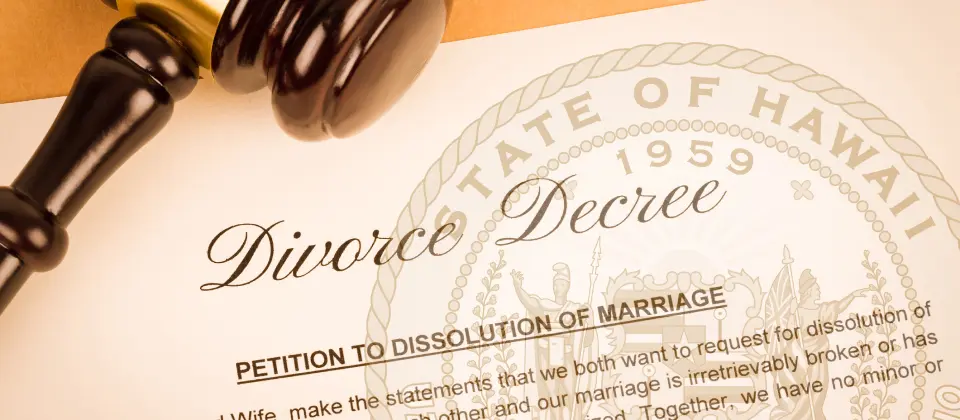
Divorce laws and record-access rules vary by state. In Hawaii, these rules are set out in the Uniform Information Practices Act (UIPA). This law allows members of the public to request access to certain court records, including divorce cases. However, access to specific case details or personal information may be restricted to protect privacy and comply with legal safeguards.
A divorce record in Hawaii is an official document confirming the dissolution of a marriage. The record is created when a spouse files for divorce and is completed once the divorce is finalized. These records may be used for personal purposes, such as updating one's legal status or verifying past marital history.
A typical Hawaii divorce record includes the following information:
Full names of both spouses
The county where the divorce petition was filed
Name of the Family Court that handled the case
Date the divorce was finalized or granted
Divorce case number
Details of rulings on property division, debt allocation, alimony, and child custody/support
Judgment type (contested or uncontested)
In Hawaii, divorce records exist in both physical and digital formats. Publicly available records, such as docket entries, hearing dates, and related filings, can be viewed online through the eCourt Kokua system. However, documents obtained from this system are not official copies; they are provided solely for personal reference in accordance with state law and system policies.
To get official divorce records or the full case file, you must go to the Family Court where the divorce was handled. Similarly, older records are generally available in physical formats such as paper files and microfilm. These are records created for cases before digital record databases were used.
In Hawaii, divorce proceedings can involve matters such as property division and child custody. As such, the information contained in a divorce record varies based on the circumstances of each case. Understanding Hawaii's divorce process clarifies which details are likely to appear in the record and how to access those records.
Where Are Hawaii Divorce Records Stored?

Before searching for a divorce record, it is always best to understand where divorce records are stored in Hawaii and how to request them. This ensures a more efficient and informed search process. Generally, you can access divorce records in Hawaii through official government channels, such as the Family Court that handled the case and the eCourt Kokua.
Hawaii divorce records are maintained by the Family Court in the judicial circuit where the divorce was finalized. You can access the records through the Legal Document Branch of the Family Court that handled the case. Divorce records typically include, but are not limited to, pleadings, motions, orders, and the final divorce decree.
Hawaii keeps certain divorce records in the eCourt Kokua system. Through this system, you can look up case details, such as docket notes and filings, using either the parties' names or the case number. In recent years, the Hawaii Department of Health (DOH) issued divorce certificates that served as concise summaries confirming a divorce. However, effective since February 1, 2026, the DOH no longer issues divorce certificates and any other divorce records.
Is Hawaii a 50/50 Divorce State
Hawaii follows the principle of equitable distribution in divorce cases. This means that family courts divide marital property fairly and reasonably. Unlike community property states, where marital assets are split evenly, Hawaii courts base property division on the specific circumstances of each case.
Under this rule, the court's focus is on what is reasonable rather than what is equal. Hawaii courts typically consider the following factors when making property division decisions in divorce cases:
Income and Earning Capacity: Courts consider each spouse's current income and their ability to earn in the future. A spouse with significantly lower earning capacity may receive a larger share of marital assets to ensure a fair outcome. This factor helps prevent economic hardship after divorce.
Each Spouse's Age and Health: The court considers each spouse's age and physical condition when deciding how property will be shared. Marital property may be shared equally if both parties are old and unable to work.
The Effect of Distribution on Children: Hawaii family courts ensure that property division does not negatively affect a spouse's ability to provide for the children's needs. As such, a custodial parent may be awarded adequate property to prevent the children from lacking.
Ability of the Dependent Spouse to Get a Job After Divorce: Courts evaluate whether the spouse who relied on the other for financial support can realistically get a job after the divorce.
Any Violation of the Law: When dividing property in a divorce, Hawaii family courts may consider whether either spouse engaged in wrongful conduct. Although divorce in the state is not granted on the basis of fault, judges may consider fault when dividing property. This is especially relevant when misconduct directly affects the assets available for distribution, such as engaging in gambling or substance abuse.
Types of Hawaii Divorce Records

In Hawaii, divorce records can be categorized into divorce certificates, divorce decrees, and divorce case files. Each type of divorce record in Hawaii serves a distinct legal or informational function, and the level of access depends on the government agency that maintains the records.
For example, a divorce certificate provides official proof of divorce and is typically required when changing one's last name or applying for a new marriage license. Certificates are issued only to parties in the divorce and authorized representatives. In contrast, a divorce decree contains the court's detailed judgment, including rulings on matters such as child support and property division. While anyone can request access to these records, certain details, such as child custody information, are redacted before disclosure.
Similarly, if you want the full story of the case, you can request the divorce case file. This includes everything filed in the case, such as complaints, summons, motions, and hearing records.
Hawaii Divorce Certificate (Certificate of Divorce)
A divorce certificate is a summary document that confirms that a divorce occurred between two people. Unlike a decree, it does not include the detailed terms of the divorce but only confirms the names of the parties, the date of the divorce, and the location where it was finalized.
Divorce certificates are primarily used for administrative purposes, such as updating marital status in government records, applying for a new marriage license, or making changes to a passport. Initially, these certificates were issued by the Hawaii Department of Health (DOH). However, under a new policy, the authority to issue divorce certificates has been transferred to the Family Court that handled the case. To obtain this record, individuals must visit the appropriate Family Court and present valid identification.
Divorce Decree (Final Judgment of Divorce)
A divorce decree is the official document issued by the court to finalize divorce proceedings. It is often required when proof of specific judicial orders is needed, such as for legal name changes or to resolve post-divorce disputes. These records are maintained by the Family Court that presided over the case and are generally available through formal court-request procedures unless sealed. A Hawaii divorce decree typically includes rulings on matters such as:
Property and Debt Division: A divorce decree outlines how marital property, including assets and debts, is divided between both parties.
Alimony: This includes details of any spousal payments the court grants to either party. It contains the type of payment, amount, and duration of spousal support.
Child Custody and Support: If the couple has a child under 18, the divorce decree will include details of child custody arrangement, visitation, and support.
Final Judgment Date: The official date the judge signs the decree. It is also the date the marriage is officially dissolved.
Divorce Case File
In addition to divorce decrees and certificates, the Hawaii Family Courts maintain complete divorce case files. These files contain comprehensive records of all filings related to the divorce, including petitions, responses, motions, custody arrangements, parenting plans, and court orders.
Case files provide a complete picture of the divorce process and can be useful if you want to review the case history or need them for legal reasons. Access to these files is subject to court policies, and certain documents may be sealed or redacted to protect privacy.
How to File for Divorce in Hawaii (Step-by-Step)
Like most jurisdictions, Hawaii imposes a residency requirement for individuals seeking to file for divorce. You can file for divorce if you or your spouse has been domiciled or physically present in the state for a continuous period of six months prior to filing. In addition, the filing party must have resided or been present in the judicial circuit where the complaint will be submitted for at least three months before filing.
Another important consideration is whether the divorce will be contested or uncontested. This distinction significantly influences the cost, complexity, and duration of the proceedings.
Uncontested Divorce: An uncontested divorce occurs when both spouses agree on all terms of the dissolution. In such cases, court appearances are not required if the judge approves the submitted forms. Typically, this process is finalized within six to ten weeks after the Uncontested Divorce by Affidavit packet is reviewed. The divorce becomes final once the judge signs the Divorce Decree and the court stamps it.
Contested Divorce: A contested divorce occurs when both parties cannot reach an agreement on one or more issues, such as child custody, visitation, alimony, child support, or division of marital assets. In Hawaii, the resolution of these disputes is determined by the judge, typically after discovery, hearings, and mediation, and potentially a trial. As a result, both parties have limited control over decisions affecting their children and marital estate, and must comply with the court's ruling
If you meet Hawaii's residency requirement and have determined the type of divorce that applies to your situation, you may proceed with the filing steps outlined below.
Step-by-Step Divorce Process
Each Family Court in Hawaii has specific local rules that apply to divorce cases. As such, it is best to find out what is applicable with the Clerk of the Family Court in the judicial circuit where you plan to file. Generally, the divorce process in Hawaii depends on whether the case is contested or uncontested and whether the couple has minor children.
Prepare the Filing Packet
At this stage, you are expected to gather, complete, and organize the necessary legal documents required by the Family Court to formally begin the dissolution of marriage.
Identify the Divorce Path (1A vs. 1B): This is where you decide if the divorce will be contested or uncontested.
Prepare the Required Documents: Assemble the following documents:
Complaint for Divorce / Automatic Restraining Order / Summons to Answer Complaint: This is a three-in-one document that officially begins the divorce process. In the form, you must provide basic information about the marriage and state the relief you are requesting. In addition, you must complete the section for the restraining order and summons.
Matrimonial Action Information: Hawaii law requires the submission of personal information of both parties in the divorce and their children.
Income and Expense Statement: Hawaii law requires anyone filing for divorce to submit a detailed income and expense statement.
Asset and Debt Statements: This form is used to report to the court all assets and debts incurred during the marriage.
Any other required forms are determined by the type of divorce being filed. You can access them through the Hawaii Judicial Branch divorce forms.
Filing Fees and Fee Waivers: To initiate a divorce case in Hawaii, a filing fee ranging from $215 to $265 is required, depending on the circumstances of the case. Filing a complaint without minor children generally costs $215, while cases involving minor children cost $265. If you cannot afford to pay the filing fee because you have a very low income, you can ask the judge to waive the filing fee.
File the Case
After organizing your paperwork and preparing the applicable filing fee, you can take the following steps to file the case:
Where to File: You are required to file the completed paperwork with the Family Court in the judicial circuit where either spouse lives.
Filing Methods: You can file your completed paperwork using any of these methods based on your preference and availability:
In Person: Visit the Family Court Clerk's office to submit all the required documents and appropriate fees in person.
Mail: If the county Family Court Clerk's office allows mail-in submission, submit the appropriate forms and proof of filing fee payment by mail.
Electronic Filing (eFiling): You can file divorce cases online through the Hawaii Judiciary Electronic Filing and Service System (JEFS).
What You Receive: Regardless of the filing method adopted, you will receive the following after filing a divorce case in Hawaii:
Assigned a case number to help you track the divorce case
The name of the judge who will handle the case
Summons if the divorce is a contested case
Initial court notices or scheduling information
Service of Process (Primarily for Contested Cases)
Under state law, the complaint for divorce and summons must be served personally on the defendant by an authorized process server if the defendant is located within the State. If personal service is not possible or the defendant resides outside the State, the court may authorize service by registered or certified mail.
If the defendant evades service, or if the plaintiff cannot ascertain the defendant's address after diligent inquiry lasting at least 15 days, the court may permit service by publication. In such cases, notice of the action and hearing must be published once a week for three consecutive weeks in a newspaper suitable for judicial notices. The hearing may proceed 21 days after the final publication.
Early Case Phase and Temporary Orders
Family Courts in Hawaii often seek to maintain the status quo during the early stages of a divorce case, especially when children are involved. The goal at this point is to minimize disruption to family life and ensure that immediate needs are addressed while the case moves forward.
A major component of this phase is discovery. Under Hawaii law, discovery is the formal process through which both spouses exchange information and documents relevant to the divorce. It allows the court to gain a clearer picture of the couple's financial situation, property holdings, and parental responsibilities.
Upon reviewing the information provided during discovery, Hawaii Family Court Judges may issue temporary orders. These are short-term measures designed to maintain balance until a final divorce decree is entered. Temporary orders can cover a wide range of urgent matters, including child custody and visitation schedules, spousal or child support payments, and the use of marital property such as the family home.
During this early phase, both spouses can expect the following to happen:
Exchange relevant information, such as financial records, to clarify the scope of the case.
File motions requesting temporary orders to resolve immediate issues like child care or financial support.
Gather evidence to show the court your need for temporary relief. Evidence could include deeds (for property or marital home), pay stubs (for support), and school records (for custody).
After mediation, the judge may hold a hearing to determine whether to issue temporary orders. These may include:
Temporary child or spousal support
Exclusive use of marital property, such as the marital home
Child custody and visitation arrangements
Restraining or protective orders when safety is a concern
Financial Disclosures and Discovery
During divorce proceedings, both spouses are legally required to provide complete and truthful disclosure of all assets, including marital and separate property, as well as business interests. Under Hawaii law, financial disclosures must be filed at the start of the divorce process, often within 30 days of the petition or as required by the local family court. Discovery provides both spouses with the information needed for a fair outcome in a divorce case.
Below are essential elements of financial discovery in a Hawaii divorce case:
Mandatory Disclosure: Both spouses must file a Sworn Statement of Income and Expenses and a Schedule of Assets and Debts. Supporting documents, such as tax returns, pay stubs, bank statements, and retirement account statements, must be provided for at least the past 2 years to substantiate the disclosed values.
Discovery Tools: If the divorce is contested, spouses can use several tools to gather the financial information needed for fair decisions about support, property, and other issues:
Request Documents: Ask your spouse for financial records like tax returns or pay stubs
Interrogatories: Send written questions that must be answered under oath
Subpoenas: Obtain financial information from third parties like banks, employers, or retirement plan administrators.
Depositions: Take sworn testimony in person, outside of court, to gather additional financial information.
Case Management and Court Conferences
After a Complaint for Divorce has been filed and served, the court typically issues a scheduling order that sets deadlines for discovery, mediation, and conferences. In contested divorce cases, a case management conference is held early in the process. This is a court-mandated meeting involving the judge, the parties, and their attorneys. The purpose of the conference is to monitor the progress of the case, ensure that discovery is proceeding appropriately, and establish a timeline for future hearings or trial.
If the judge determines that the case is not progressing as expected, they may:
Clarify contested issues in relation to agreed-upon terms
Establish deadlines for discovery, expert evaluations, and depositions
Order mandatory mediation to address complex matters such as child custody
Issue temporary orders to resolve immediate concerns, including alimony, possession of the marital residence, and temporary child support
Settlement or Trial
In Hawaii, divorce cases are resolved either through settlement or by proceeding to trial. A divorce settlement is a legally binding agreement between spouses that addresses all matters related to the divorce, including division of assets, allocation of debts, child custody, and support obligations. Settlement options include:
Signing a marital settlement agreement
Negotiating directly with your spouse
Participating in mediation with a neutral facilitator
When spouses cannot reach a settlement, the case goes to trial. At trial, the following typically occurs:
Evidence and witness presentation
Submission of proposed findings and judgments by each side
Judicial rulings on all unresolved issues, including the equitable distribution of marital property
Judgment, Waiting Periods, and Finalization
Unlike many states, Hawaii does not impose a mandatory waiting period after a divorce petition is filed. This means that once all required paperwork has been properly completed, filed, and approved by the court, the divorce may be finalized without additional statutory delays. The absence of a waiting period allows cases to move forward more efficiently.
Child Custody and Child Support in Hawaii Divorces
In a divorce case involving children, the court's primary concern is protecting the child's overall welfare. Custody and child support are two critical issues that can significantly affect a child's life during divorce proceedings. In Hawaii, these matters are decided by considering what is in the child's best interest. To make this determination, the court may review the following factors:
Any history of neglect or emotional abuse of a child by a parent
The overall quality of the parent-child relationship
The history of caregiving or parenting by each parent prior to and subsequent to a marital or other type of separation
The emotional needs of the child
The physical health needs of the child
Each parent's cooperation in developing and implementing a plan to meet the child's ongoing needs
Any history of sexual or physical abuse of a child by a parent
Legal Custody vs. Physical Custody
In Hawaii, custody can be legal or physical, and parents may share one or both types depending on the situation. The court decides custody based on what is best for the child and the importance of each parent having meaningful contact with the child. However, if the court finds that a parent cannot act in the child's best interests, meaningful contact may be disregarded.
After a hearing, Hawaii family courts may order joint custody if they conclude that joint legal custody, joint physical custody, or both, promote the child's welfare.
Legal Custody: This grants a parent authority to make major decisions regarding the child's education, healthcare, religious upbringing, and overall welfare.
Physical Custody: Concerns the child's living arrangements and daily care. This may be shared on a schedule or given primarily to one parent, with the child residing mostly with that parent.
Child Support Guidelines and Enforcement
Under Hawaii law, both parents are legally obligated to provide financial support for their children. Child support orders may be issued, modified, terminated, or enforced by the court. The amount of support is determined according to statewide child support guidelines, which must be applied in all cases unless exceptional circumstances exist. These guidelines consider the parents' incomes, their ability to pay, and the child's needs to set a monthly support amount. The principles underlying Hawaii's child support guidelines include:
Each parent must retain sufficient income to meet basic needs and maintain employment.
A child's essential needs are prioritized before parents keep any additional income.
If income remains after meeting the basic needs of both parents and children, each child is entitled to share in that surplus so they may benefit from both parents' higher standard of living.
A child support order becomes legally enforceable after it is issued by a family court. Hawaii uses several methods to address nonpayment. These enforcement options include:
Driver's license or professional license suspension
Wage withholding (automatic deduction from paycheck)
Interception of federal and state tax refunds
Initiating court actions that may result in penalties, including fines or jail time
Property, Debt, and Alimony in Hawaii Divorces
In a divorce case, the court must decide how to divide marital assets and debts and whether to award alimony.
Hawaii is an equitable distribution state, meaning marital property is shared in a manner that is fair and reasonable. The state uses the Marital Partnership Model in property division. Under this model, each spouse is entitled to reimbursement for contributions made to partnership property. The model recognizes three categories of property:
Premarital Separate Property: Property owned before marriage or cohabitation, which later becomes either marital separate or marital partnership property.
Marital Separate Property (MSP): Property kept outside the marital partnership and not divided at divorce.
Marital Partnership Property (MPP): All other property, including most assets and debts, is divided between the spouses.
During a divorce in Hawaii, the court also considers marital debts. Marital debt refers to obligations incurred during the marriage for the benefit of both spouses. It sometimes includes debts created after separation but before the divorce is finalized. When dividing marital debt, the court looks at:
Each spouse's financial ability to repay
Which spouse incurred the debt, and why
Whether the debt benefited one spouse, both spouses, or the marriage itself
The overall distribution of marital property
In Hawaii divorces, alimony may be awarded to help a spouse who is not currently working or who needs time to complete education or training for future employment.
Common types of alimony in the state include:
Temporary Alimony: Provides immediate financial support during the divorce.
Periodic Alimony: Recurring payments made to a spouse at regular intervals, typically every month.
Rehabilitative Alimony: Helps a spouse gain skills or education to become financially independent.
Lump-Sum Alimony: A one-time or fixed payment made in full or over a set period.
Errors, Omissions, and Corrections in Hawaii Divorce Records
Divorce records often contain mistakes such as incorrect dates, misspelled names, missing details, or other clerical errors. Most divorce records are legally binding documents that govern your financial, property, and custodial rights. An error on a divorce record can cause long-term financial hardship, hinder the sale of assets, or lead to legal disputes and contempt-of-court charges.
To correct an error in your divorce records, you must contact the Family Court that decided your case and include any information or supporting documents that will assist the court in determining whether there is a mistake in the court record. The judge will review the request and decide whether a correction or amendment is appropriate.
Once the court approves the correction, you may obtain updated copies of the certificate or decree from the Family Court Clerk's office in the judicial circuit where the divorce was finalized and the decree updated.
How to Access Hawaii Divorce Records
Generally, you can access Hawaii divorce records online, in person, and by mail. The type of Hawaii divorce record you require determines where to look.
Online Access
Divorce Decrees: Hawaii does not issue divorce decrees online. You can access these records in person or via mail. However, you can search for other divorce records, including docket entries, court dates, and related filings, using the statewide eCourt Kokua system. This system allows searches by name and case number. You are required to pay $3 to download a document from the system.
Divorce Certificates: Hawaii no longer issues them online. You can obtain your divorce certificate by contacting the family court that handled your case. Expect to pay a fee for each copy of your divorce certificate.
In-Person Request
Divorce Decrees: Hawaii divorce decrees are maintained by the Family Court Clerk's office in the circuit where the divorce was finalized. To obtain a decree in person, visit the Family Court, submit a request form with ID, and pay applicable fees.
Divorce Certificates: To obtain a copy of a divorce certificate in Hawaii, you must visit the Family Court that handled your case. You will be required to provide any of the IDs listed on the form and pay the appropriate fee. In most cases, copies of the divorce certificate you seek will be issued while you wait. Divorce certificates are typically issued only to the individuals named in the case and their legal representatives.
Mail-in Request
Divorce Decrees: Contact the Family Court Clerk's office in the circuit where the divorce was finalized to confirm if they offer mail-in services for full divorce decree requests.
Divorce Certificates: Mail requests must be directed to the Family Court that handled the case, as Hawaii's vital records office no longer issues divorce certificates.
Hawaii Courthouses That Handle Divorces
When initiating a divorce in Delaware or seeking divorce records, it is important to know which court has jurisdiction and where to file the case. Divorce cases are handled by a specific level of the state court system.
Court Authority for Hawaii Divorce Cases
The Family Courts in Hawaii have jurisdiction over all domestic relations matters, including divorce, paternity, child support, and custody disputes. This authority is granted under Hawaii Revised Statutes (HRS) Chapter 580 and is exercised within the state's unified court system.
County-Based Filing
Court records in Hawaii are maintained at the county level. As such, it is essential to know where to file a divorce case or request copies of full divorce decrees. Generally, the appropriate venue is the judicial circuit where the defendant resides.
Here are places to find final divorce decrees for some popular Hawaii counties:
O'ahu Island: O'ahu Family Court
Kaua'i Island: Kaua'i Family Court
Hawai'i: Hawai'i Family Court
Jurisdiction Basics
In Hawaii, all divorce cases are filed with the Family Court. Under state law, the Family Court may hear a divorce case even if one spouse does not consent. The Court also has jurisdiction over divorces involving couples who were legally married in another state or country, provided they meet Hawaii's residency requirements. You may file for divorce in Hawaii if you believe the marriage is irretrievably broken or cannot be fixed.
Examples of Hawaii District Courts
Each county in Hawaii is home to at least one Family Court. Here are examples of Family Courts in the state:
O'ahu Family Court (1st Judicial Circuit of Hawaii)
Kaua'i Family Court (5th Judicial Circuit of Hawaii)
Hawai'i Family Court (3rd Judicial Circuit of Hawaii)
Role of the Family Court Clerk
The Family Court Clerks play the following key roles in Hawaii divorce cases and records:
Accept divorce filings/petitions and assign case numbers to each filing
Issue court notices and summonses
Maintain the official case files for all divorce matters decided in the district court
Provide certified copies of divorce decrees and related orders to eligible individuals
FAQs
Are Divorce Records Public in Hawaii?
Yes, in Hawaii, divorce records are considered public. However, access to the complete case files is restricted when they contain sensitive details such as information about minors, mental health, or domestic violence.
What Is the Difference Between a Certificate and a Decree?
A Hawaii divorce certificate is a summary record of a finalized divorce case, while a divorce decree is the full, legally binding court order.
Do I Need to Know the County?
Yes, you need to know the county where the divorce was filed to locate the decree. The divorce decree is available at the Family Court Clerk's office in the judicial circuit where the divorce was finalized.
How Far Back Do Records Go?
Hawaii divorce certificates date back to 1951 and are maintained by the Family Court that handled the case.
How Much Does It Cost?
A divorce certificate costs $10, while certified copies of decrees generally cost $2-$5 per page, depending on the county.
Can I Search Hawaii Divorce Records for Free?
Hawaii divorce record searches are not free. All record searches, including case information searches, divorce decrees, and divorce certificates, require a fee.
Table of Contents
- Where Are Hawaii Divorce Records Stored?
- Is Hawaii a 50/50 Divorce State
- Types of Hawaii Divorce Records
- How to File for Divorce in Hawaii (Step-by-Step)
- Step-by-Step Divorce Process
- Child Custody and Child Support in Hawaii Divorces
- Property, Debt, and Alimony in Hawaii Divorces
- Errors, Omissions, and Corrections in Hawaii Divorce Records
- How to Access Hawaii Divorce Records
- Hawaii Courthouses That Handle Divorces
- FAQs